


The Three Christs of Ypsilanti
 |
 |
 |
 |
 |
- Publication Date: 1964
- Written by: Milton Rokeach
- Page count: 342
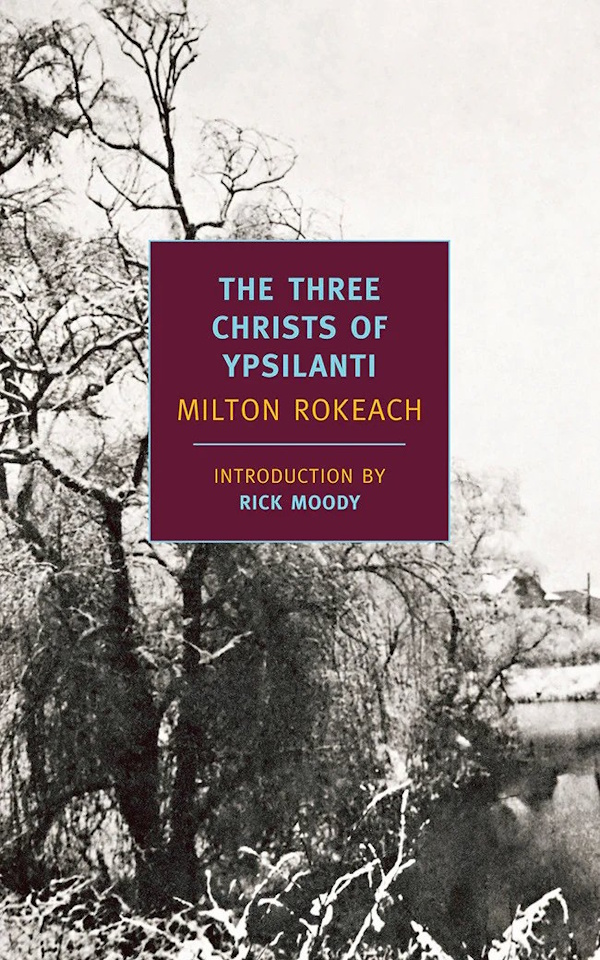
Over the past few years, my girlfriend has gotten me a small selection of books pertaining to studies of the mind. It started when she bought me a copy of Oliver Sacks' The Man Who Mistook His Wife for a Hat for Christmas, and not long after reading Hat, I followed it up with another one of Sacks' books, Awakenings. Before reading these two books, I had never read any sort of medical study in my life, but Sacks' blending of easy-to-understand medical analysis and a strong sense of compassion for the patients he wrote about turned me on to a type of nonfiction that I've come to really enjoy. The Three Christs of Ypsilanti is yet another medical study that she bought for me as a gift. I had never heard of it before, but the eye-catching title was enough to spark my interest: a look at three off-kilter minds with some spiritual undertones sounded like a fascinating read. As a whole, this is probably the most thorough and humanizing of the studies I've read, even if some of the methods used in the study would probably turn a lot of heads today.
Three Christs covers a study done by social psychologist Milton Rokeach between the years of 1959 and 1961 at Ypsilanti State Hospital in Michigan. His area of study largely dealt with people's beliefs about themselves and how those beliefs affect how we form our identities and interact with those around us. His hypothesis for the study was that if three people with the same delusional beliefs about their identity were brought together to meet and form a relationship, their delusions would gradually dissipate because the human mind can't rationalize more than one person sharing the same identity. The subjects of this study were three men known by the aliases Joseph Cassel, Clyde Benson, and Leon Gabor. While all three men held several delusional beliefs about their personhood to various extents, they all shared the same belief that they were the reincarnation of Jesus in one way or another.
Of the case studies that I've been through, this one was probably the easiest to understand as a layman. Rokeach doesn't bog the book down with excessive amounts of complex medical terminology, nor does he flood the page with a large amount of footnotes and external references, and this makes it very approachable to everyday readers. He offers enough easy-to-understand psychological history to lay down the groundwork of his study, and in a few chapters he does offer his analysis of the subjects and how their delusional beliefs formed, but these more complex sections aren't the main focus here. The bulk of the book consists of long conversations between Rokeach and the three men in their own words, transcribed from hours' worth of taped group sessions, one on one interviews, and letter excerpts. It's organized in an almost day-by-day fashion, and this gives the reader a very intimate look into how each man's beliefs about themselves changed (if at all) and how their relationships developed over time. Having so much of the book consist of the patients' own words is an amazing way to get to know these people on a more personal level, and I think that puts this book slightly above the two Oliver Sacks books that I've read so far. Aside from these men's delusions, you get a feel for the things that they value in life, what worries them, their insecurities and trauma that led them to retreat into delusion, and how they feel about the world and each other. It's pretty heartwarming to see them grow to care about one another to a certain degree, even if they have fierce disagreements over who is the "real Christ" and continuously dismiss each other as "crazy."
Despite the title, I was sort of surprised to find out that the book isn't really about "three Christs," but rather two. Clyde was the eldest of the three, and had been in the hospital for the longest amount of time. At this point, he had been in a delusional mindset for so long that he simply didn't engage as much, and was pretty much beyond Rokeach's help. Because of this, most of the focus is on Joseph and Leon. In fact, Leon has the most coverage out of all of them due to how complex and ever-changing his delusions were. His upbringing by an extremely religious and abusive mother left him with deep-seeded feelings of self-loathing, distrust towards women, and extreme sexual frustration. He was obsessed with the idea of sin and "dying the death" so he could be reborn into a new person, eventually resorting to referring to himself as "dung" because there was nothing lower to him than excrement. His chapters were honestly pretty hard to read at points because they largely consist of pages upon pages of looping, ever more delusional talk. It gets so absurd that at a certain point, he genuinely believed that he was married to a Yeti woman who was also his mother who was also God. While some of his actions towards his fellow patients did aggravate me, it's incredibly sad to read about a young man with a whole life in front of him constantly retreating into twisted delusions of grandeur to escape what he perceives as an inherently evil self.
Despite how fascinating of a study this was, I can't ignore the fact that it's not the most ethically sound one by today's standards. At a certain point, Rokeach felt that the group sessions had reached the end of what they were able to do, so he began to play into each man's delusions to try to alter their thinking patterns. His rationale behind this was solid enough: humans develop their beliefs from those they trust at a primal level, so if he posed as one or more of those figures and nudged them towards more rational thinking, he thought that that could break them of their delusions. Nowadays it's pretty shocking to imagine a psychologist deliberately lying to and manipulating their patients in an effort to cure them, but since this area of study was still developing at the time, I guess it seemed like a good idea to him. While at first it's admittedly a little amusing to read Rokeach posing as Leon's imaginary wife or the head of the hospital that Joseph thinks of as a father, it's just sad to see how negatively this impacted the men. His manipulations led them into deep confusion and anger, and it made them distrust both each other and Rokeach. The experiment was ultimately unsuccessful, and if the book ended there, I wouldn't blame any readers for thinking that Rokeach was both a bad doctor and person. However, my copy of the book contains an afterward written 20 years later, and I think that Rokeach's own words do a great job of illustrating his regret over how he handled their treatment:
"[...] while I had failed to cure the three Christs of their delusions, they had succeeded in curing me of mine - of my God-like delusion that I could change them by omnipotently and omnisciently arranging and rearranging their daily lives within the framework of a "total institution." I had terminated the project some two years after the initial confrontation when I came to realize - dimly at the time but increasingly more clearly as the years passed - that I really had no right, even in the name of science, to play God and interfere around-the-clock with their daily lives."
Moral failings and all, The Three Christs of Ypsilanti is a great read. Rokeach's choice to largely let the men speak for themselves does a really good job of painting pictures of actual human beings instead of circus exhibits, and his willingness to admit that what he did was wrong shows a lot of personal growth from a man who was so dedicated to his study that he was willing to play God in the process. Despite our best intentions, certain things are not meant to be fully understood, and it's probably for the best that something as complex as the human mind remains a bit of a mystery to us.
