One On Top of the Other (Perversion Story)
 |
 |
 |
 |
 |
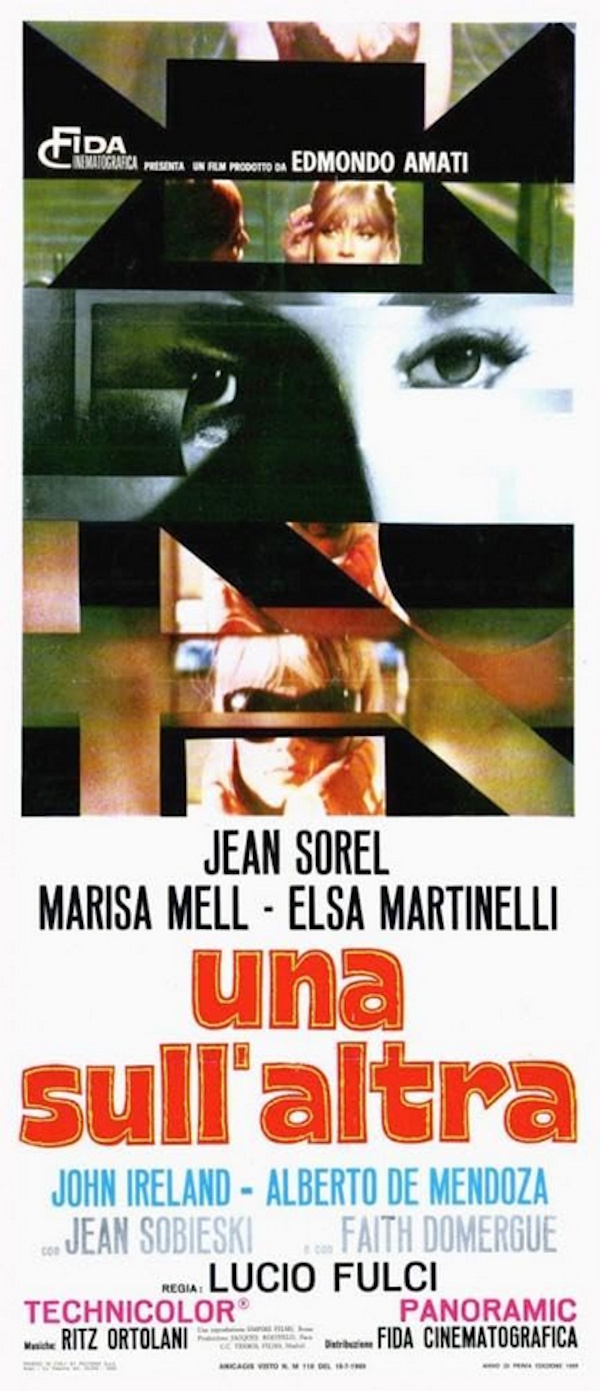
- Release Date: August 15, 1969
- Directed by: Lucio Fulci
- Written by: Lucio Fulci, Roberto Gianviti and Jose Luis Martinez Molla
- Runtime: 1 hour 48 minutes
From a historical standpoint, One On Top of the Other is one of the most important movies in Lucio Fulci's filmography. It marked a major turn in his career after almost exclusively directing comedies throughout the second half of the 50s and most of the 60s. Most of these comedies pretty much stayed in their lane in terms of genre, but Fulci started to play around with different subgenres of comedy as he went on - be it sci-fi, crime, or even war. Prior to this, his only venture entirely outside the world of comedy was a single spaghetti western in 1966. One On Top of the Other was Fulci's very first giallo film, made as the subgenre was taking off after Mario Bava pretty much invented it with 1963's The Girl Who Knew Too Much. While not a true "horror film" by any means, it's an important first step towards the world of horror from a director who would eventually become one of the Italian masters of the genre.
The plot of the movie concerns George, a wealthy doctor in San Francisco who runs a clinic with his younger brother. George is in an unhappy marriage with his wife Susan, and while he's away on a trip with his mistress, he's shocked to find out that Susan suddenly died and left him a million-dollar insurance claim. As the police begin to become suspicious of George and his multiple business dealings, he meets a stripper named Monica who looks almost identical his deceased wife, except she has differently colored hair and eyes. His encounters with Monica lead him to become obsessed with who she really is, if his wife is truly dead, and who exactly is pulling all these strings behind the scenes. While this movie falls into the giallo subgenre, it's not exactly the sort of thing that the term "giallo" eventually came to be known for. Thanks to Bava's Blood and Black Lace and later works from directors like Dario Argento, giallos are typically thought of as murder mysteries featuring graphic, slasher film-like death sequences and sleazy characters. While a death and the mystery surrounding it is crucial to the plot here, there are no elaborate murders to be found - surprisingly, there's no onscreen violence at all! The focus is entirely on the relationships between the characters and their investigation of the mystery at hand, and because of that this movie feels a lot closer to his later giallo The Psychic, which always makes me think of a Hitchcock film. In fact, I've read that some people compare this movie to Vertigo, but since I still haven't seen Vertigo, I can't comment on how accurate of a comparison that is.
While this movie may be lacking in the violence and gore department, it definitely makes up for that with an abundance of sex and female nudity. This is an example of what some people call a "sexy giallo," as eroticism is the big draw here rather than bloodshed. So many scenes in this movie are just excuses to show off beautiful women. Aside from standard sex scenes, there are a few scenes of models doing naked photo shoots, and a couple of sequences feature dozens of dancers in an elaborate strip joint, complete with a big swing on the ceiling and a motorcycle for Monica to dance on. Riz Ortolani's score really helps to emphasize the sensual atmosphere. It features lots of saxophones that can range from silky-smooth to so loud that they begin to squeak, and some nice bass guitar licks and clarinet solos give it a groovy feel that fits perfectly with the spirit of late-60s sexual freedom. Some people may think that Fulci was just being horny behind the camera, but I think he was just trying to deliver what the audience wanted to see. And given that this movie was a decent success, I guess he did a pretty good job at it!
Speaking of cameras, a lot of Fulci's recognizable camera tricks that would be repeated in his horror films are still present here. He makes heavy use of handheld camera shots, and the old habit of zooms on people's faces or objects to show importance is used pretty often. His trademark zoom-ins on and close-up shots of people's eyes are here as well, which was another aspect that kept making me think of The Psychic. I also really like some of the perspectives that he pulled off in the handheld sequences. One great example is an overhead shot looking down on Monica as she walks through an airport. Abruptly, the camera pulls straight down to her level, revealing that it was shooting a reflective ceiling the entire time. Another interesting perspective shift occurs in the opening sex scene. It starts out being shot normally, and then at a certain point, it switches to a shot looking upwards from below the bed. The entire frame is shot through the semi-transparent red sheets, with the silhouettes of bodies writhing and seemingly floating on them. If that's not an awesome visual metaphor for "dangerous passion," then I don't know what is. The editing also has a few fun touches, such as a couple of montages that consist of several shots playing simultaneously on screen in small cut-out windows, which looks very 60s in design. It's all put together so well, and since this was one of Fulci's first genre films, it feels like you're watching the prototype versions of techniques that would be perfected later on.
After all that praise, I do have to admit that the final act feels a little off. The big twist of the movie is revealed with 20 minutes left to go, and even though the last 20 minutes are crucial to the plot, they feel tacked-on because the early reveal threw off the movie's pacing. The ending also commits one of my personal movie sins, which is revealing the final resolution of the story through exposition dialogue rather than actually showing the characters going through the events. I'm fine with how the story was resolved as a whole, but simply having it told to the audience via a news reporter is a pretty clumsy ending to an otherwise good movie. Still, I think I can look past that shortcoming because of all the highlights I laid out earlier.
One On Top of the Other isn't my favorite giallo that Fulci made, but for his first outing in the genre, it's not bad at all! There's enough intrigue in the plot to keep you guessing the entire time, and some great camerawork and excellent music wrap up this sexy mystery in a nice little bow. The movie can be a little hard to find on home media these days, but I recommend any fan of Fulci's genre work to track it down. Any master of their craft has to start somewhere, and this movie shows that he definitely had a solid foundation to build off of.