


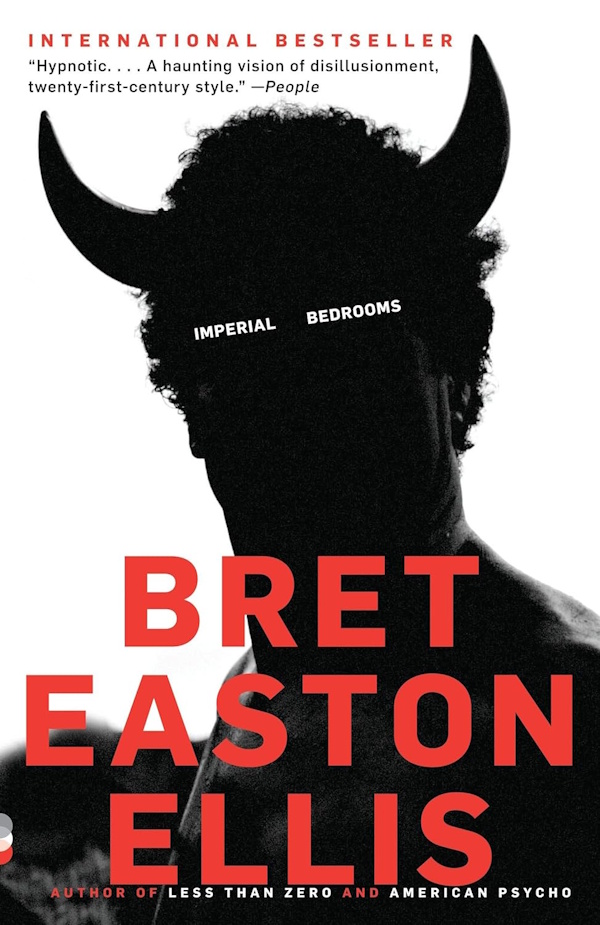
Imperial Bedrooms
 |
 |
 |
 |
 |
- Publication Date: June 15, 2010
- Written by: Bret Easton Ellis
- Page count: 169
I think any creatively minded person is guaranteed to experience a range of emotions when they go back and revisit their first work. They'll likely feel some degree of embarrassment due to how unrefined their skills are, and the thought of "I really should have done X, Y and Z differently" will probably come up more than once. In rarer cases, the creative will still feel a sense of resonance with their work, being able to put themselves in the mindset of their younger self and take the piece on its own merits. Being able to appreciate your older work is one thing, but choosing to add onto it in the form of a years-later sequel is often a risky move. The passage of time greatly changes how we feel about ourselves, the world, and of course, our art - and sequels made years after the fact run the risk of simply being a retread of a bygone era. With that being said, how did it turn out when Bret Easton Ellis decided to write a sequel to his debut novel after 25 years had passed?
Imperial Bedrooms picks up in real time after the events of Less Than Zero. Clay, the original novel's protagonist, is now an established screenwriter in Hollywood. Many of his old friends from his teenage years are also involved in the industry and continue to live the lifestyles of wealthy, powerful socialites. Others have spent the past two decades sinking deeper into their addictions to drugs and sex, never truly growing up and becoming increasingly vile with age. At first, Clay appears to have straightened up to a degree between novels. But when he's asked to cast an actress named Rain in a film based on one of his scripts, he becomes increasingly obsessed with her, leading him to slip ever deeper into the darkest parts of his personality. While Less Than Zero read like a series of short, unfinished sequences narrated by a kid recovering from a drug binge, Imperial Bedrooms is a more straightforward narrative being told by a man who is desperate to hide from who he is at his core. The gradual unraveling of Clay's more straightened-up persona is the driving force of this book, and as it goes on, it becomes very obvious that he has deep psychological demons that are being brought to the surface by his relationship with Rain. His possessiveness and obsession with women is his biggest and darkest one, and it's not surprising that a character who was exposed to sex and the drug-fueled party life as a young teen would develop some unhealthy attitudes towards women. This is where Clay morphs from a detached observer into a cold and paranoid psychopath, which isn't a shocking turn of events coming from the same man who wrote American Psycho.
The changes to Clay's character in this book are drastic, and at many points it feels like you're not even reading about the same person anymore. While he still hung around with plenty of horrible people in Less Than Zero, he still had enough of a moral compass in him to realize that some of the things his friends were doing were clearly not OK. Sure, he never did anything to intervene and spent a lot of time simply watching in stoned wonder, but he at least had it in him to question their actions and begin to ask if the rampant drug use and corruption of young people's lives was truly "living" at all. In Imperial Bedrooms, the crude mask of the grown-up and changed Clay is disposed of only a few chapters in, and you quickly discover that that dark curiosity lurking in his teenage mind has grown in to a cruel and sadistic monster. This is all shown through his relationship with Rain, which swings from one extreme to another - deep, passionate love followed by bitter contempt and resentment, and eventually to horrific violence. After their initial spark has passed, almost every act of kindness that Clay shows towards Rain is an excuse to keep her briefly happy before manipulating her into getting drunk and having sex with him. When she begins to ask too many questions and push him to keep his promise of giving her a part, he pumps her full of more drugs and alcohol and has sex with her again. It's unnerving enough to read sequences of a protagonist beating, verbally abusing and sexually assaulting his love interest, but when it's written in the same style of detached observation as Less Than Zero, it feels even more gross and simply gets uncomfortable by the halfway point. He views Rain (and seemingly any woman he's been with) as simply a piece of meat to be used and disposed of at his whim, and at a point in time where stories of Hollywood figures abusing their power and status to exploit young and vulnerable actresses are sadly all too common, it makes Clay's treatment of Rain feel disgustingly believable.
I mentioned before that Clay feels like an entirely different character here, and this book has an interesting way of making some of the horrible changes in him work in the story... to a degree. Famously, Less Than Zero got a pretty sanitized and moralizing film adaptation in the 1980s, and Imperial Bedrooms opens with Clay talking about that very movie being made. In-universe, Less Than Zero was a novel written by "some writer" who hung around in the same group of people that Clay knew, and according to him, that writer perceived him and his friends "flatly" and left out aspects of their personalities and lives. Turning the original book into an in-universe piece of thinly veiled fiction gave Ellis a good opportunity to give his thoughts on a film adaptation of his work that was viewed by many as an inferior version, as well as a chance to put the mindset of his younger self aside by turning him into a character and commentating on him with a quarter of a century's worth of experience and hindsight. This metafictional angle could imply that the monstrous aspects of Clay's adult personality were always there in his younger self to a lesser degree, and the writer simply left them out because he didn't know Clay that well. But if I'm being honest, it also feels like a bit of a lazy excuse for Ellis to simply sweep everything that readers expected off the table and write another Patrick Bateman-type character. The intentions are neat, but I can't help but feel that the execution is a little half-baked.
On top of that, there are many unresolved plot threads that simply go nowhere, and the book loses a bit of its momentum because it makes you ask a lot of questions that it never gives answers to. There is a running subplot of some unknown person stalking Clay with threatening text messages and breaking into his apartment, but it never gets any sort of resolution in the story. Some of his old friends seem to know what is happening behind the scenes, but when he confronts them, no one says what exactly is going on. It does serve the purpose of illustrating Clay's paranoia, since he's always afraid of women leaving him, shadowy figures out to get him, or associates working against him in one way or another. But when there's not even an implied resolution and it just seems to come and go as it pleases in the story, it feels like a tacked-on attempt at filling up page space. I guess the point of it could have been to make the reader constantly wonder and ask questions in the same way a paranoid psychotic would, but if you ask me, it needed some much better pacing and payoff to make the plot detours worth the read.
I'm honestly not sure how I feel about Imperial Bedrooms. Part of me appreciates the book for how grimy and uncomfortable of a read it is, and I do like some of its ideas about the dark parts in people's minds that they try to repress until they can't any longer. However, the degree to which it changes Clay's character feels like Ellis was simply burning his own creation down and playing in the ashes as he did so. I'll at least give it points for not being a hollow retread of the novel that started his career. Check it out if you're curious, but if you end up putting it down at any point, I can't say I blame you for it.
